

There is a specific kind of silence that happens in a crowded room when a speaker is killing it on stage. It is the silence of rapt attention, where three hundred people hold their collective breath because the CEO just dropped a vision for the next decade that actually sounds inspired. But for a significant portion of the professional population, that silence is not a choice; it is a barrier. When we host corporate events, we often spend weeks obsessing over the font size on the PowerPoint slides or the exact shade of the lanyard, yet we frequently overlook the fundamental mechanics of how our message reaches every ear: or every eye: in the room.
At Auerbach International, we have spent over three decades watching the global business landscape shift from localized hubs to a truly interconnected web. We have seen that communication is never just about the words being spoken; it is about the bridge built between the speaker and the listener. In the American context, providing American Sign Language (ASL) interpretation is often viewed through the narrow lens of legal compliance. It is a box to be checked to satisfy the Americans with Disabilities Act. However, if we view accessibility only as a regulatory hurdle, we miss the profound transformation that happens when an event becomes a truly inclusive powerhouse.
The High Stakes of Mere Compliance
If we treat inclusion as a chore, the result is usually a disaster. We have all seen it: the interpreter tucked into a dark corner behind a potted plant where they are invisible to the people who actually need to see them. Or worse, the "volunteer" who learned a bit of sign language in college and is now drowning in a sea of high-level technical jargon. In essence, "good enough" is never good enough when your brand’s reputation and your audience’s engagement are on the line. When a company fails to provide professional interpretation services, they aren't just risking a lawsuit; they are signaling to a massive market segment that their presence is an afterthought.
There are roughly 500,000 Americans who use ASL as their primary language. These are C-suite executives, engineers, marketing directors, and creative visionaries. When you invite them to your event but fail to provide a Master's-level interpreter who understands the nuance of your industry, you are effectively locking the doors to your most important rooms. Americans who challenge these assumptions don't always understand that ASL is not just English with hand motions. It is a distinct, vibrant language with its own syntax, grammar, and cultural nuances. If your event involves complex data or specific industry terminology, you need more than a signer; you need a linguistic expert.

The Multi-Modal Advantage for Everyone
One of the most fascinating things we’ve observed in our 35-plus years of language services is that accessibility features often benefit people who didn't even realize they needed them. Think about the "curb-cut effect." Sidewalk ramps were designed for wheelchair users, yet they are used every day by parents with strollers, travelers with rolling suitcases, and delivery drivers. ASL interpretation functions in much the same way.
When a professional interpreter is positioned prominently, they provide a visual anchor for the entire audience. This multi-modal approach to communication: where information is delivered both auditorily and visually: actually increases retention rates across the board. For the non-native English speakers in your audience, seeing the physical expression of the speaker's tone and urgency through the interpreter can clarify points that might have been lost in a thick accent or a noisy ballroom. Even for those with perfect hearing, the presence of an interpreter adds an energy and a cadence to the presentation that keeps the brain engaged.
If your event is being recorded for future use, having that ASL overlay or a dedicated transcription and interpretation strategy ensures your content has a longer shelf life and a wider reach. You are es- sentially future-proofing your intellectual property. Is "good enough" still the standard you want to aim for?
The Master's-Level Difference
Of course, the quality of this experience hinges entirely on the caliber of the interpreter. This is where many organizations stumble. They might look for the cheapest option, assuming that all sign language is created equal. But at the corporate level, the stakes are simply too high for amateur hour. Our Master's-level interpreters are not just translating words; they are translating concepts, tone, and intent.
Imagine a high-level technical symposium where a lead developer is discussing the intricacies of blockchain architecture. A general-purpose interpreter might struggle to find the signs for "decentralized ledger" or "cryptographic hash," leading to a confusing mess of fingerspelling that leaves the Deaf attendee trailing behind the conversation. In contrast, a specialized technical interpreter will have pre-studied the materials, understood the jargon, and can deliver a fluid, real-time translation that allows the Deaf professional to participate in the Q&A with the same speed and confidence as anyone else. If you wouldn't hire a high school student to handle your technical translation services, why would you settle for less than a pro for your live event?

THE BLOOPERS THAT BROKE THE ROOM
We wouldn't be doing our job if we didn't point out the lighter: and sometimes cringeworthy: side of what happens when professional standards are ignored. We call these our "learning moments," but in the moment, they usually feel like a nightmare. There was the instance of a major tech conference that relied on a generic AI-generated avatar for their sign language. The software, unable to process the regional slang the speaker was using, began twitching and eventually signed something that looked remarkably like a request for a ham sandwich in the middle of a discussion about cybersecurity.
Then there was the well-meaning coordinator who hired an "interpreter" based on a social media video. During the keynote, it became painfully clear the individual was just performing rhythmic hand-dancing that bore no resemblance to ASL. The Deaf attendees were baffled, and the hearing attendees were distracted by what looked like a one-person interpretive dance recital during a fiscal year-end review. These stories are funny in retrospect, but they represent a total failure of the inclusive mission. They happen because organizations forget that language services are a professional discipline, not a decorative add-on.
The Modern Landscape of Virtual and Hybrid Inclusion
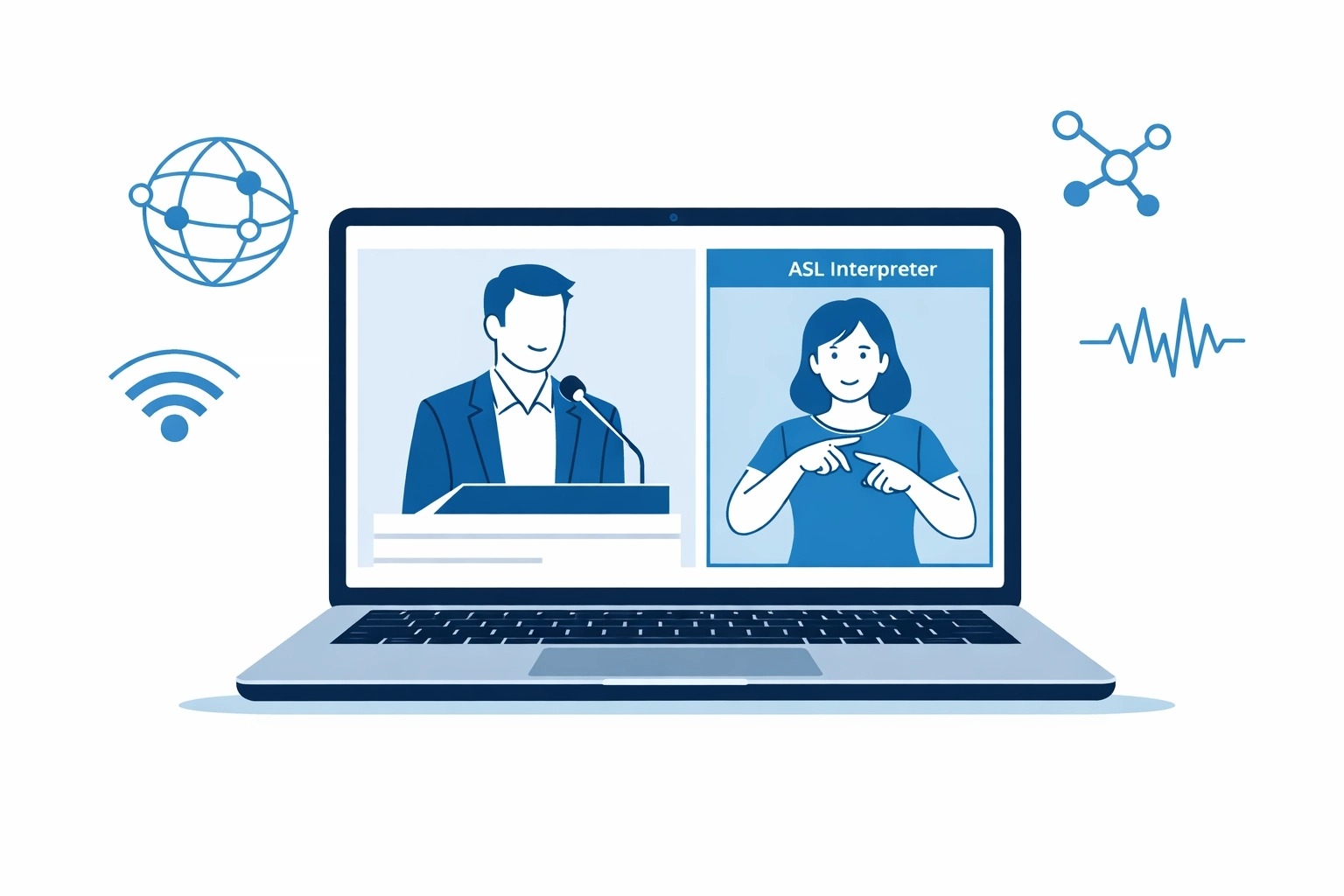
As we move further into the era of hybrid events, the definition of the "room" has changed. We are no longer just talking about physical ballrooms; we are talking about Zoom windows and streaming platforms. This shift has actually made professional ASL interpretation more accessible than ever, provided it’s done right. Modern platforms allow for dedicated video windows where the interpreter can be pinned, ensuring that the Deaf participant has a clear line of sight regardless of who is sharing their screen.
In essence, the geographical barriers are falling. We can now bring in specialized interpreters from across the country to cover niche topics without the overhead of travel costs. However, this requires a level of technical coordination that goes beyond just sending a link. It involves testing lighting, ensuring low-latency connections, and providing the interpreter with "prep packets" well in advance. At Auerbach International, we emphasize that requesting an interpretation quote should be one of the first things on your event planning checklist, not the last.
A Commitment to the Whole Audience
When you walk into an event and see a professional ASL interpreter working in tandem with the keynote speaker, you are seeing a company that values precision. You are seeing a leadership team that understands that their message is only as powerful as its ability to be understood. This isn't just about avoiding an ADA complaint; it’s about fostering an environment where every employee, partner, and client feels that the company has invested in their success.
Inclusion changes the energy of a corporate culture. It signals to the hearing staff that the organization cares about detail and empathy. It signals to the Deaf and hard-of-hearing staff that their professional growth is a priority. It transforms a standard corporate gathering into a powerhouse of shared ideas and collective momentum.
If you are planning your next major meeting or global summit, ask yourself if you are truly reaching everyone. If there is a silence in your room that shouldn't be there, it might be time to bridge the gap. Whether you need a team for a live conference or a certified solution for your training videos, the goal remains the same: total clarity, for everyone, all at once.
CONCLUSION
True inclusivity in corporate events is achieved not through gestures, but through the seamless integration of Master's-level ASL interpretation that honors the intelligence of the audience and the integrity of the message.

