

When a Bay Area software company pushes its product into a new market, the first impression users in that market receive is often shaped not by features or design — but by language. Every button label, error message, tooltip, and help article sends a signal: we built this for you, or we translated this for you. The difference is what professional software localization services deliver.
Localization is not a synonym for translation, though translation is part of it. A translated product renders words from one language into another. A localized product behaves as if it was built for a specific market — with date formats, currency symbols, pluralization rules, text expansion, keyboard shortcuts, and cultural references all adapted to feel native to the user. For companies in the Bay Area building products that reach Tokyo, Berlin, São Paulo, or Riyadh, that distinction determines whether an international launch succeeds or stalls.
Professional linguists and localization specialists reviewing multilingual software interfaces for global deployment.
What Is Software Localization — and Why Does It Matter?
Localization (often abbreviated as l10n in the tech industry) is the process of adapting software so that it works correctly, communicates clearly, and feels natural to users in a specific locale. That includes the language, but it also includes the entire user experience:
- Text translation and adaptation — every UI string, message, and label rendered accurately in the target language
- Date, time, and number formats — switching from MM/DD/YYYY to DD.MM.YYYY, or using the correct decimal separator for the market
- Currency and unit conversions — displaying prices in local currency with the correct symbol placement
- Text expansion and UI layout — German and Spanish strings are typically 25–40% longer than English equivalents; layouts must accommodate this without breaking
- Right-to-left (RTL) support — Arabic, Hebrew, and Farsi require mirrored layouts and bidirectional text handling
- Cultural adaptation — icons, color choices, and imagery that carry specific meaning in one culture may confuse or offend users in another
- Legal and regulatory compliance — some markets require specific disclosures, privacy language, or content restrictions
For a company headquartered in San Francisco or San Jose, these are not abstract concerns. The Bay Area produces some of the world's most widely used software — and the world's most demanding users notice when a product treats their language as an afterthought.

What Professional Software Localization Services Include
When a company engages professional software localization services, the scope typically covers several interconnected disciplines. Auerbach International's approach — and that of any serious localization provider — integrates all of the following:
A localization team reviews software strings, UI layout, and cultural context for a Bay Area technology product.
String Extraction and Translation
Every piece of user-facing text in a software product — whether in a mobile app, a web platform, or a desktop application — must be extracted, translated by a qualified linguist, reviewed, and reintegrated. A translator who is fluent in the target language but unfamiliar with software products will produce technically correct but contextually wrong output. He or she may not recognize that "Cancel" in a dialog refers to a user action rather than an event cancellation, or that a terse UI label like "Submit" needs to be rendered very differently depending on the form context.
Terminology Management
Software products accumulate specialized vocabularies over time — product names, feature labels, proprietary terminology, and industry-specific terms. Professional localization services maintain glossaries and translation memories that ensure consistency across every string, release, and language. Without this infrastructure, the same term translates differently across UI elements, documentation, and support content, which erodes user trust.
Linguistic Quality Assurance
Translation is followed by review — ideally by a second qualified linguist who checks accuracy, fluency, consistency, and contextual appropriateness. This step is not optional. Errors that survive into a shipped product reach users at scale. For our clients across industries, we've observed that the cost of fixing a localization error post-launch — resubmitting an app to a store, issuing a corrective update, managing user complaints — far exceeds the cost of a proper review cycle before release.
Desktop Publishing and UI Adaptation
Translated text does not always fit the original layout. A button labeled "Send" in English may become "Verzenden" in Dutch or "Enviar" in Spanish — both longer, both potentially breaking the UI if the container has no flexibility. Professional localization services include a DTP or UI adaptation pass that adjusts layouts without requiring developers to go back and redesign the interface manually.
Functional and Linguistic Testing
The final stage involves testing the localized product in context: verifying that text renders correctly, that no strings are missing or truncated, that date and number formats behave as expected, and that the localized version of the software actually works as the user expects. For complex products, this is a meaningful amount of work — and skipping it is how untested localization errors reach production.
Why AI-Only Tools Fall Short in Software Localization
Automated translation tools have improved significantly in recent years, and they play a useful role in certain contexts — drafting first passes, handling simple repetitive strings, or generating content for internal use where precision is not critical. But for software localization intended for end users, AI-only translation introduces a category of errors that is difficult to detect without native-language expertise.
The failures are not usually about missing words. They are subtler: a mistranslated modal verb that turns a suggestion into a command; an idiomatic English phrase rendered literally in German in a way that reads as bizarre; a technical term that exists in the source language but has no clean equivalent in the target, and whose translation requires a qualified specialist to choose the best local convention. A linguist reviewing AI output will catch these issues. An automated QA tool will not.
For companies shipping technical software products where the user interface is part of the value proposition, the quality of the localization is directly visible to users. In competitive international markets, a product that feels clumsily localized loses ground to alternatives that feel native — even if the underlying features are comparable.
The Bay Area Context: Global Products, Global Stakes
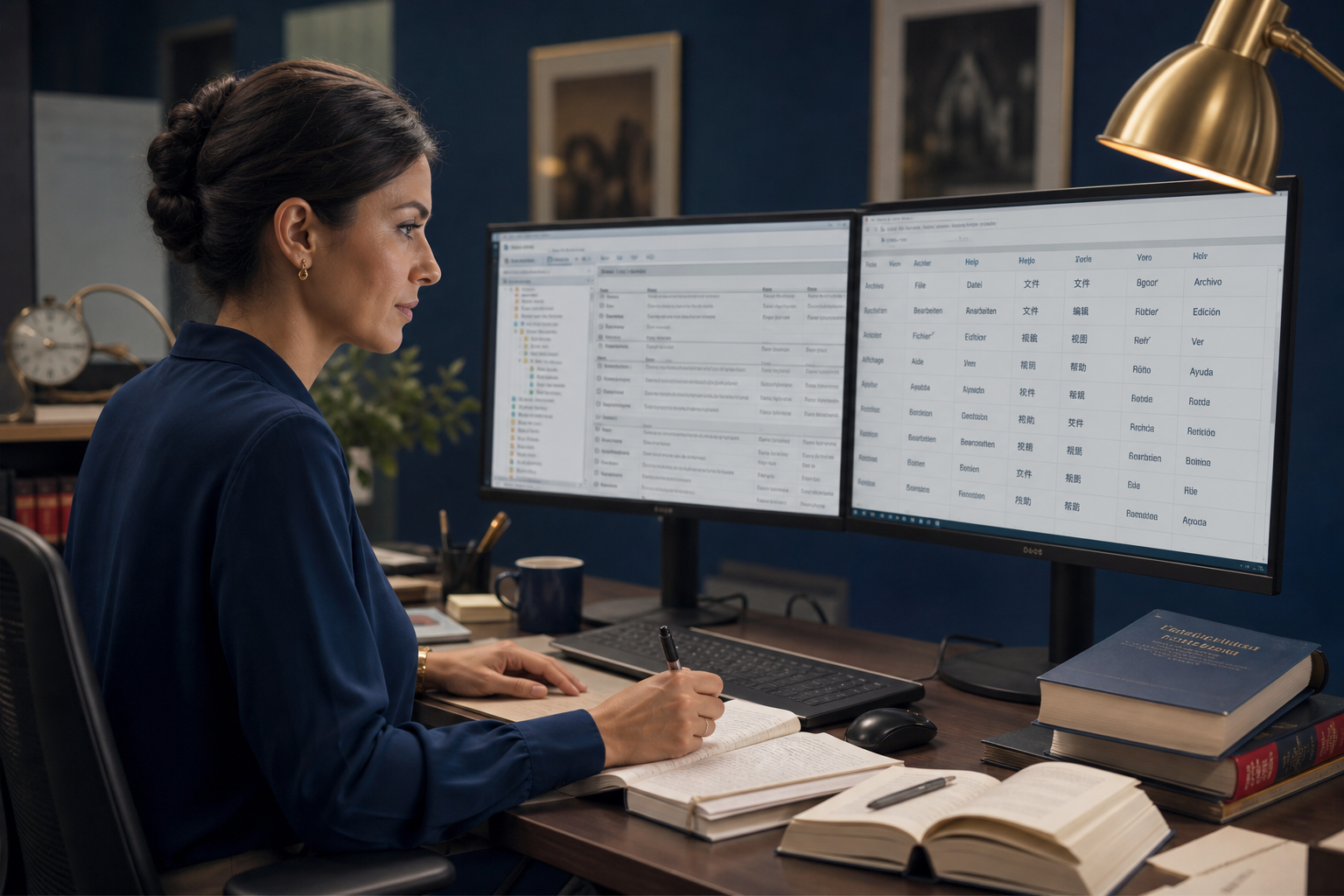
Bay Area tech companies expanding into global markets rely on professional localization to ensure their products feel native to each audience.
The Bay Area software ecosystem has a particular relationship with international markets. Many of the world's most widely used platforms — productivity tools, developer tools, fintech applications, healthcare platforms, SaaS products — originate here. Their user bases are genuinely global, which means their localization requirements are complex and consequential.
Japanese users have specific expectations around formality levels that are built into the grammar of the language itself. The same product message may need to be rendered formally for a B2B platform and conversationally for a consumer app — and a translator who is not a domain specialist may not know the difference. German users expect precision and completeness in technical language. Portuguese-speaking users in Brazil and Portugal share a language but not a dialect, a vocabulary, or in many cases a regulatory environment. Arabic-speaking markets span dozens of countries with distinct preferences, formal registers, and regional vocabulary.
These are not details that automated tools handle reliably. They are exactly what qualified human linguists — the kind Auerbach International has been working with for over 35 years — bring to every project.
The industries we serve in the Bay Area and beyond span language solutions for technology, healthcare, legal, manufacturing, and government sectors. Each carries its own localization requirements, its own regulatory context, and its own user expectations. There is no single-size approach that works across all of them.
What to Look for in a Localization Partner
Choosing a localization provider is not the same as choosing a translation vendor. The scope is larger, the technical requirements are more complex, and the risk of a poor outcome is higher because errors reach users at scale. Here are the questions every Bay Area tech company should ask before engaging a localization partner:
Do They Have Domain Expertise?
A linguist who translates software strings all day understands product UI, error messages, and technical terminology. A generalist translator does not. Look for evidence of experience with software products specifically, not just broad translation services.
Do They Maintain Translation Memories and Glossaries?
Translation memories ensure that the same string is always rendered consistently, and that previously approved translations are reused when strings repeat across releases. Without these tools, every release is effectively a fresh translation, with all the consistency risks that implies.
Do They Support Your Technical Workflow?
Modern software teams work with file formats like XLIFF, JSON, PO files, and Android/iOS resource files. A serious localization partner can integrate into these workflows — often connecting directly with platforms like Phrase, Lokalise, or Transifex — rather than requiring manual file exports and reimports.
What Does Their QA Process Look Like?
Ask for specifics. Who reviews the translation, and what are their qualifications? What tools are used for linguistic QA? Is there a separate functional testing phase? If the answers are vague, the QA process is likely not rigorous.
Do They Have References from Similar Projects?
A provider who has localized software for fintech companies in Japan, or SaaS products for German enterprise users, can speak from experience about the specific challenges those markets present. That track record is worth more than a general claim of expertise.
How Auerbach International Approaches Localization
Auerbach International has been providing professional language services since 1991 — over 35 years of working with companies that need more than word-for-word translation. Our team covers 120+ languages and includes specialists with deep expertise in the sectors Bay Area companies work in most: technology, healthcare, legal, and financial services.
For software localization specifically, we bring the same discipline that has made our translation and localization services a trusted resource for multinational organizations. That means qualified linguists with software experience, rigorous review processes, and a commitment to accuracy that extends beyond the surface-level meaning of words to the contextual and cultural meaning that users actually experience.
We work with each client to understand the product, the target market, and the specific requirements that define success. A mobile consumer app entering the Japanese market has different localization needs than a B2B SaaS platform expanding into Germany. We build processes that fit the actual project, not a generic template.
If your Bay Area tech company is preparing for an international expansion — or if a previous localization effort has produced results that aren't meeting expectations — we can help you assess the situation and build a plan that will get it right. Request a quote to start the conversation.
Frequently Asked Questions About Software Localization Services
What is the difference between software localization and translation?
Translation converts text from one language to another. Software localization adapts the entire product — including text, UI layout, date and number formats, cultural references, and regulatory requirements — so that it feels native to users in a specific market. Translation is one component of localization; localization is the broader discipline.
How long does software localization typically take?
Timelines depend on the volume of text, the number of target languages, the complexity of the product, and the thoroughness of the QA process. A small mobile app entering one new language market may be localizable in a few weeks. An enterprise platform entering five markets simultaneously may require several months of coordinated effort. Auerbach International works with each client to establish timelines that fit both the project scope and the product roadmap.
Can AI tools replace human localization for software products?
AI tools can accelerate parts of the process — generating first-pass translations, handling repetitive strings, or flagging potential issues. But AI-only localization introduces a category of errors that requires native-language expertise to catch: idiomatic failures, cultural mismatches, technical terminology decisions, and context-dependent nuance. For software shipped to end users, human review is not optional.
Which languages do Bay Area companies most commonly localize for?
The most common target languages for Bay Area tech companies include Simplified Chinese, Japanese, Korean, German, French, Spanish, Portuguese (Brazil), Arabic, and Italian — often referred to in the industry as "FIGS plus" or "tier-one" locales. The right language priority list depends on the product's target markets and the revenue opportunity in each. Auerbach International covers all of these and many more.
Does Auerbach International handle localization for regulated industries?
Yes. We have significant experience with software in healthcare, legal, financial services, and government contexts — each of which carries specific regulatory requirements that affect how localized content must be rendered. A localization provider who specializes in consumer software will not necessarily understand what is required in a HIPAA-regulated environment or in a product that must meet EU accessibility standards.
Ready to Localize Your Product for Global Markets?
Auerbach International has helped companies reach global audiences in 120+ languages for over 35 years. We bring the same rigor to software localization that we bring to every project — qualified linguists, structured review processes, and a track record you can verify.

