


The Stakes Are Different in Legal Settings
Every word in a deposition is on the record. Every answer a witness gives — filtered through an interpreter — becomes testimony that may be cited in briefs, presented at trial, or scrutinized by opposing counsel for years. In most professional contexts, a minor translation slip is a nuisance. In a legal proceeding, it can be a turning point.
California courts handle millions of cases involving non-English-speaking parties each year. The Bay Area, in particular, sits at the intersection of dozens of immigrant communities and global business relationships — meaning depositions involving Mandarin-speaking executives, Spanish-speaking workers, Arabic-speaking witnesses, and dozens of other language groups are a daily reality for local law firms.
Yet legal interpretation is routinely underprepared. Attorneys sometimes book the first available interpreter without verifying credentials, legal vocabulary depth, or subject-matter familiarity. The result is a deposition transcript riddled with hedged answers, confused witnesses, and terminology that doesn't hold up in court.
This guide covers what separates professional court interpretation services from an unqualified stopgap — and what Bay Area attorneys should require before their next deposition.
Types of Legal Interpretation
Not all legal interpretation is the same. Understanding the modes helps attorneys match the right format to each proceeding.
Consecutive Interpretation
The speaker pauses after each statement. The interpreter then renders the full passage in the target language. This is the standard mode for depositions, attorney-client interviews, witness preparation meetings, and any setting where attorneys need to track every statement in real time and interrupt if necessary. Accuracy is paramount; speed is secondary.
Simultaneous Interpretation
The interpreter speaks at virtually the same time as the source speaker, using a slight delay. This mode is used in courtroom hearings, trial proceedings, and multi-party legal conferences where a pause-and-render format would make proceedings impossibly slow. Simultaneous interpretation requires a higher cognitive load and is typically performed in pairs, with interpreters alternating every 20–30 minutes to maintain accuracy.
Over-the-Phone Interpretation (OPI)
Remote phone-based interpretation has become a practical tool for attorney consultations, immigration interviews, and discovery calls — especially when a rare language is needed on short notice. Auerbach International's OPI services connect law firms with qualified interpreters in 120+ languages, typically within minutes for common languages.
Video Remote Interpretation (VRI)
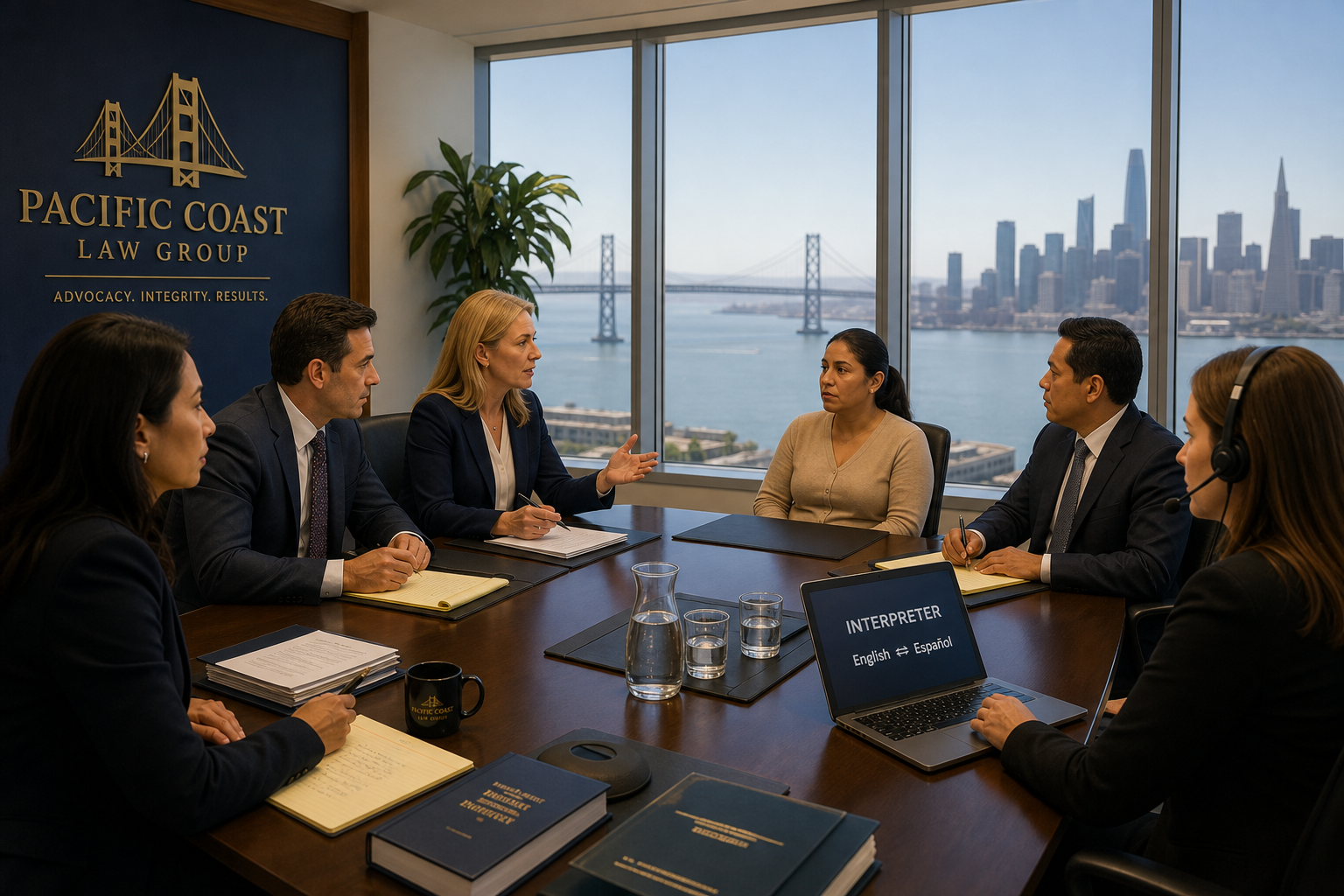
VRI combines the accessibility of remote interpretation with the visual channel that supports nuanced communication — useful for deaf or hard-of-hearing witnesses through ASL, or for depositions conducted across geographic locations. Bay Area firms increasingly use VRI for depositions where parties are in different cities or when travel costs are prohibitive.
Depositions: What Interpreters Must Get Right
Depositions are the most technically demanding context for legal interpretation. Several factors make them uniquely difficult:
Legal terminology must be precise
"Discovery," "deposition," "motion in limine," "stipulation," and "objection" all carry specific procedural meanings that must be rendered accurately — not approximated. An interpreter who paraphrases or substitutes a different legal concept creates a record that opposing counsel can challenge.
Witness answers must be fully rendered — not summarized
Amateur interpreters often compress or summarize witness answers, especially when a witness speaks at length. A qualified court interpreter renders every word — including hedges ("I think," "maybe," "I'm not sure"), qualifications, and contradictions — because those elements are legally significant.
The interpreter must remain neutral
A court interpreter is not an advocate. He or she must resist any temptation to smooth over an answer, fill in a gap, or soften language. Even well-intentioned "clarifications" can alter the evidentiary record in ways that undermine a case.
Subject-matter expertise matters
A deposition in a patent infringement case involves different vocabulary than one in a medical malpractice case. Interpreters who lack subject-matter familiarity struggle when technical terms appear — and they will. Auerbach International selects interpreters with documented experience in the relevant practice area: intellectual property, employment law, personal injury, immigration, corporate litigation, and more.
One multi-year client reported that a prior agency had assigned interpreters whose unfamiliarity with technical vocabulary during complex depositions forced the firm to re-depose witnesses — at significant cost. After switching to Auerbach International, the same client noted that our interpreters came prepared with terminology briefings and zero re-deposition incidents over an extended engagement.
California Rules and Certification Requirements
California has some of the most rigorous interpreter certification requirements in the United States, administered through the Judicial Council of California.
- Criminal proceedings: California law requires a certified or registered court interpreter in criminal proceedings. Certified interpreters have passed the California Court Interpreter Examination; registered interpreters have passed a written exam and met language proficiency standards in languages where no certification exam exists.
- Civil proceedings and depositions: The law does not always mandate certification for civil depositions, but courts and attorneys strongly prefer certified interpreters — and opposing counsel may challenge uncertified interpretation. The safer practice is to always use a certified or highly qualified interpreter.
- Federal courts: The Court Interpreters Act governs federal proceedings. Interpreters in federal court must be certified by the Administrative Office of the U.S. Courts for the relevant language. For languages without federal certification, they must be an "otherwise qualified" interpreter, which requires demonstrated competency.
- Immigration proceedings: USCIS interviews, immigration court hearings, and asylum proceedings have their own interpreter requirements that overlap with — but are not identical to — state court rules.
Auerbach International coordinates interpreters who meet California Judicial Council standards, federal court requirements, and USCIS guidelines. Our team verifies credentials before every assignment.
The Bay Area Language Landscape
The San Francisco Bay Area is one of the most linguistically diverse regions in the country. According to U.S. Census data, roughly 44% of Bay Area residents speak a language other than English at home. For law firms serving this population — or representing corporate clients with international operations — this creates a near-constant need for qualified interpretation.
The most requested languages for legal proceedings in the Bay Area include:
- Spanish (the most common by a wide margin in California courts)
- Mandarin and Cantonese
- Vietnamese
- Tagalog
- Korean
- Russian
- Arabic
- Punjabi
- Hindi and other South Asian languages
Beyond these major languages, Silicon Valley's technology sector brings a steady stream of international executives, engineers, and witnesses from across Europe, Southeast Asia, and Latin America. Auerbach International's track record across industries — from Fortune 100 technology firms to Bay Area nonprofits — reflects the breadth of legal language needs in this region.
Five Costly Mistakes Law Firms Make When Booking Legal Interpreters
1. Confusing bilingualism with interpretation skill. Many bilingual employees or community members are recruited to interpret in a pinch. Being fluent in two languages is a necessary starting point — not a qualification. Professional legal interpreters have formal training in consecutive technique, legal terminology, and neutrality protocols. Bilingual staff members have none of these.
2. Booking interpreters who haven't worked in the relevant practice area. A skilled medical interpreter may struggle in an IP patent deposition. Subject-matter experience is as important as language fluency. Always ask the agency to confirm that the assigned interpreter has relevant practice-area experience.
3. Failing to provide case materials in advance. A prepared interpreter performs measurably better than an unprepared one. Sending the case summary, key terminology, and any technical documents 24–48 hours before the deposition gives interpreters time to research vocabulary — a standard practice at Auerbach International.
4. Using remote interpretation platforms without vetting the interpreters. Many on-demand OPI/VRI platforms route calls to the first available interpreter with no verification of legal experience or certification. These services are appropriate for casual communication — not depositions. Always verify that remote interpreters are screened for legal credentials.
5. Underestimating language variation. "Spanish" is not one language for interpretation purposes. A witness from rural Guatemala may use vocabulary and expressions that differ markedly from Mexican or Castilian Spanish. The same is true for Arabic dialects, Chinese languages, and many others. A qualified agency matches interpreters to the regional variety the witness actually speaks.
What a Qualified Legal Interpreter Looks Like
When law firms work with Auerbach International, they receive interpreters who meet a consistent standard:
- Native fluency in the target language, with documented command of regional dialects relevant to the witness
- Formal interpreter training — not just bilingualism. Our interpreters understand consecutive technique, note-taking conventions, and professional ethics
- Legal vocabulary depth — familiarity with the procedural and substantive terms of the relevant practice area
- Certification where required — California Judicial Council certification or federal certification for applicable languages
- Pre-assignment briefing — interpreters review case materials before the deposition
- Neutrality and professionalism — our interpreters understand their role is to render testimony, not edit it
Auerbach International has provided interpretation services to government agencies, Fortune 100 companies, and legal teams across the Bay Area for more than 35 years. Founded by Philip Auerbach — International MBA, Thunderbird School of Global Management, and Adjunct Professor of Translation Project Management at the Middlebury Institute of International Studies — the firm brings deep institutional expertise to every legal engagement. Our Master's-level linguists bring subject-matter depth that general-purpose agencies simply cannot match, and our project managers are available throughout every assignment to handle logistics, credential verification, or last-minute changes.
Need a certified interpreter for an upcoming deposition or court proceeding?
Tell us the language, date, and proceeding type — we'll match you with a qualified interpreter fast.
Frequently Asked Questions
What is the difference between a court interpreter and a conference interpreter?
A court interpreter works in legal settings — depositions, courtrooms, attorney-client meetings — and must understand procedural terminology, evidentiary language, and legal rights. A conference interpreter typically works in business or diplomatic settings and does not need the same depth of legal vocabulary. Court interpreters are often required to be certified by state or federal bodies.
Is a certified court interpreter required for depositions in California?
California law requires a certified or registered court interpreter in criminal proceedings. In civil depositions, while certification is not always legally mandated, attorneys and courts strongly prefer — and often require — certified interpreters to protect the evidentiary integrity of the record. Uncertified interpretation can be challenged and may result in depositions being thrown out.
What languages are most in demand for court interpretation in the Bay Area?
Spanish is by far the most requested language in California courts. Mandarin, Cantonese, Vietnamese, Tagalog, Korean, Arabic, Russian, and Punjabi are also frequently needed in the Bay Area, reflecting the region's diverse immigrant population. Auerbach International covers 120+ languages, including rare dialects that are difficult to source.
What is consecutive interpretation and when is it used in legal proceedings?
In consecutive interpretation, the speaker pauses after every sentence or paragraph and the interpreter renders the full passage in the target language. This method is standard for depositions, attorney-client meetings, and witness interviews because it allows attorneys to follow every statement precisely and intervene if needed. Simultaneous interpretation — where the interpreter speaks at the same time as the speaker — is reserved for court hearings and trials where speed matters.
Can Auerbach International provide remote interpretation for depositions?
Yes. Auerbach International provides remote over-the-phone interpretation (OPI) and video remote interpretation (VRI) for depositions, attorney consultations, and other legal proceedings. Remote interpretation is especially useful for rare languages, urgent timelines, or when parties are in different locations.
How far in advance should I book a court interpreter for a deposition?
For common languages like Spanish, booking 48–72 hours in advance is typically sufficient. For less common languages, or when you need a certified interpreter with specific legal expertise, plan for at least one week. Rush requests can often be accommodated — contact Auerbach International to discuss your timeline.
What happens if a court interpreter makes an error during a deposition?
Interpretation errors in depositions can be grounds to challenge testimony, delay proceedings, or in serious cases, invalidate portions of the evidentiary record. Common risks include mistranslated legal terms, missed nuances in witness answers, or interpreters who lack subject-matter knowledge of the underlying dispute. Using a qualified, experienced interpreter is the only reliable protection.
Protect Your Case. Book a Qualified Legal Interpreter.
Every deposition, courtroom proceeding, or attorney-client meeting conducted through an unqualified interpreter carries legal risk. The cost of getting it wrong — a challenged transcript, a lost motion, a re-deposition — far exceeds the cost of booking the right interpreter from the start.
Auerbach International has served Bay Area law firms, government agencies, and multinational corporations with professional interpretation services for more than 35 years. Our interpreters bring legal vocabulary, subject-matter expertise, and the professionalism that precision legal work demands. With coverage across 120+ languages — and same-day availability for the most common — we're ready when your case is.

