

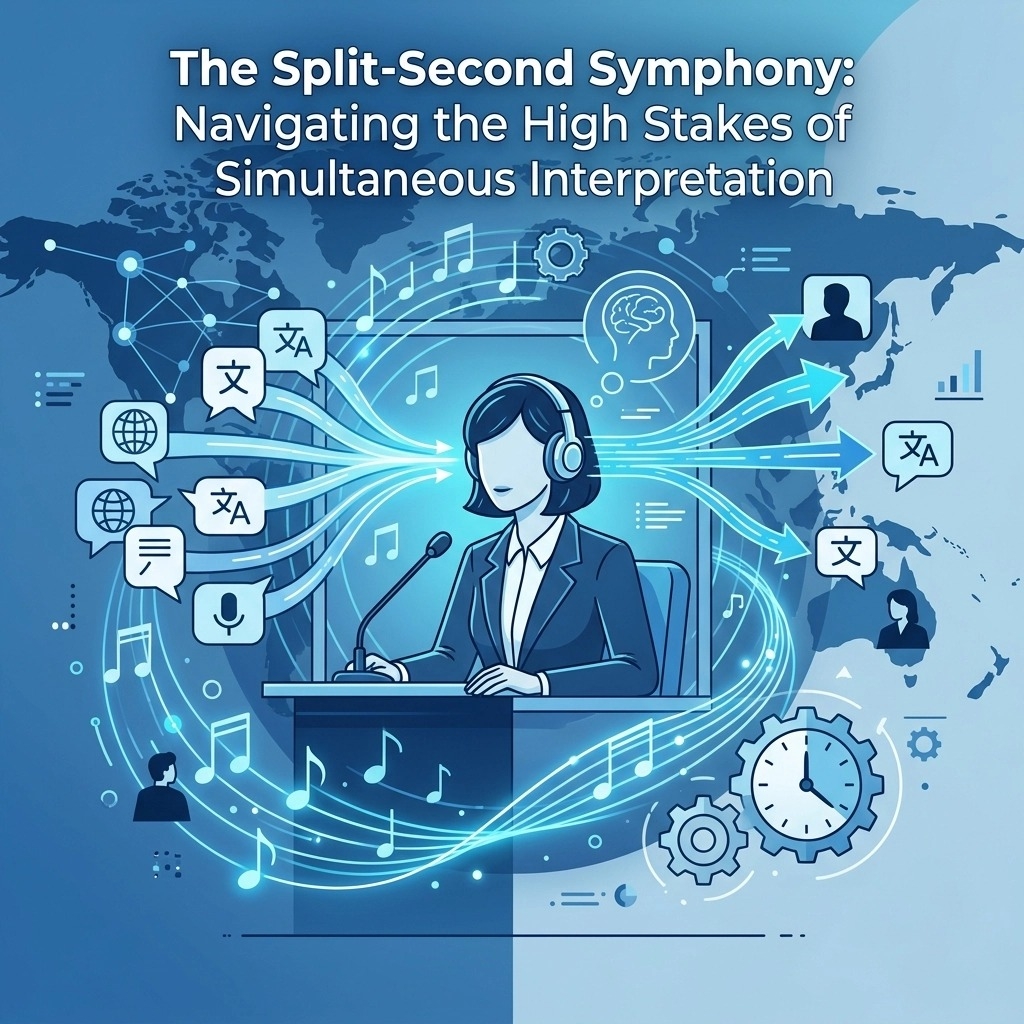
The air inside the soundproof booth always felt thinner than the air in the grand ballroom below, a pressurized environment where silence was the only currency until the microphones went live. Elena adjusted her headset, feeling the familiar weight of the padded earcups as she looked through the double-paned glass at the sea of delegates from sixty different nations. Below her, the hum of anticipation was a physical presence, a low-frequency vibration that rattled the water glasses on the mahogany tables. She was not merely a listener or a speaker; she was a conduit, a living bridge across which millions of dollars and years of diplomatic negotiation would soon travel. This was the highstakes world of interpretation services, a discipline where there is no delete key and no second chance to get the sentence right.
As the moderator stepped to the lectern, Elena’s hand hovered over the console. In this profession, timing is not just a preference but a biological necessity. She practiced the art of simultaneous interpretation services, a skill that requires the human brain to function like a dual-core processor running at maximum capacity. To reach this level of proficiency, Elena had undergone years of rigorous training, culminating in a Master's-level degree specifically designed to handle the cognitive load of hearing one language while speaking another. It is a feat that many neuroscientists find baffling, as the brain must suppress its natural instinct to wait for a speaker to finish a thought before processing the meaning. Instead, Elena lived in the décalage, that narrow three-to-five-second window of time between the speaker’s utterance and her own delivery.
The first speaker, a legal expert from Madrid, began his opening statement at a blistering pace. Elena’s voice remained calm and melodic as she translated his complex legal jargon into English for the delegates wearing headsets. She navigated the intricate labyrinth of international law, drawing upon the deep well of knowledge she had built over decades. Every word was chosen with surgical precision, ensuring that the nuances of the original Spanish were preserved without losing the clinical accuracy required for legal interpretation services. She knew that a single mistranslated verb could alter the entire meaning of a contract or a treaty, leading to disputes that might take years to resolve. At Auerbach International, this level of precision is the standard, as the company understands that global communication is only as strong as its weakest link.
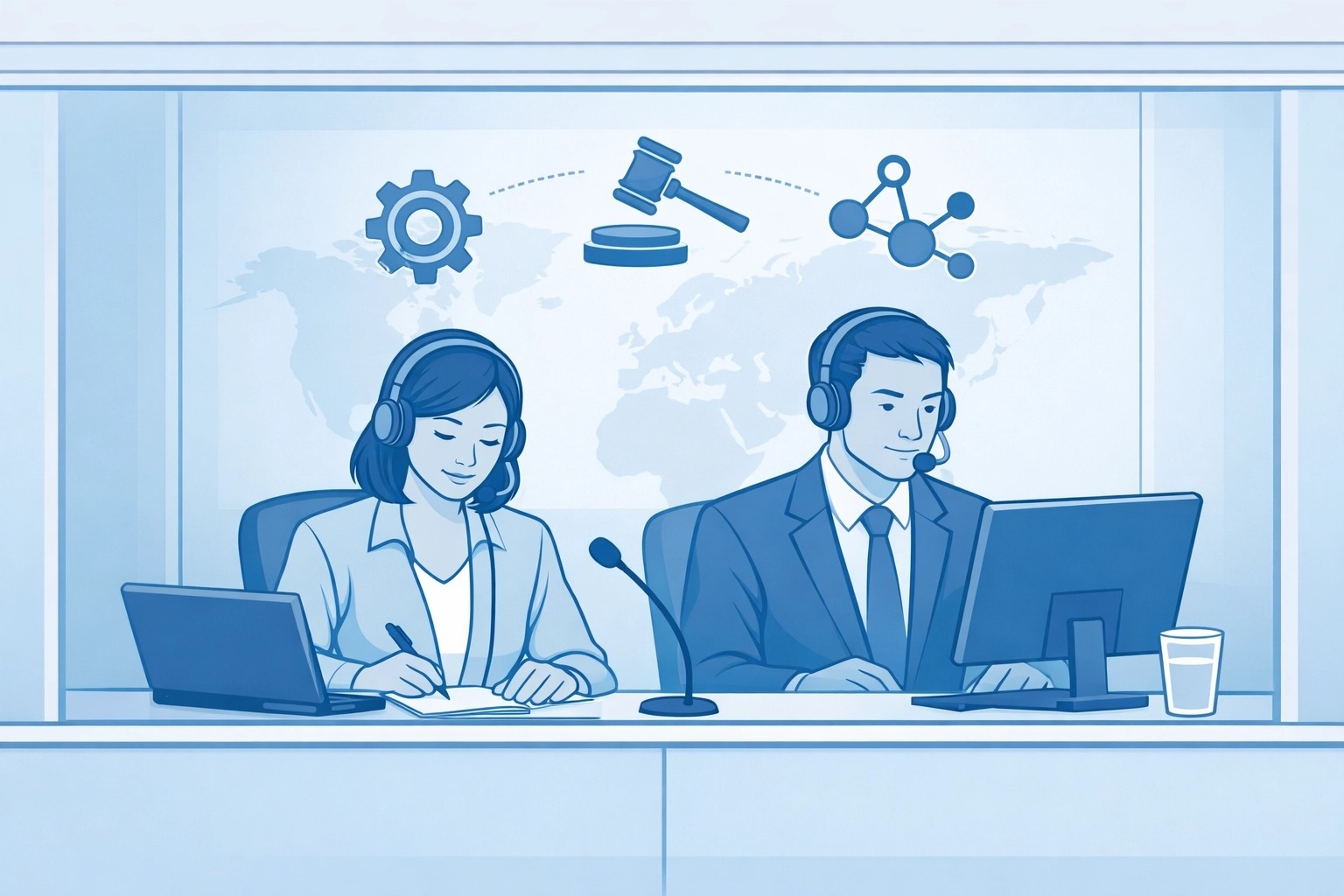
Beside her, Marcus sat in silence, his eyes fixed on a technical glossary they had prepared weeks in advance. In the world of elite interpretation, no one works alone. The mental fatigue of simultaneous work is so intense that the brain’s cognitive functions begin to degrade after approximately thirty minutes. This is why professional interpreters work in pairs, rotating like seasoned pilots to ensure that the quality of the output never falters. Marcus was her safety net, ready to jot down a specific date, a complex number, or a technical term that might slip through the cracks of her concentration. They were a team, a synchronized unit that functioned with the wordless understanding of a professional orchestra.
As the session moved into a discussion regarding environmental regulations and engineering specifications, the vocabulary shifted dramatically. Elena handled the transition seamlessly, shifting from legal phrasing to the specialized terminology of technical translation services. She spoke of carbon sequestration, thermal gradients, and kilowatt-hour efficiencies as if she had spent her life in a laboratory rather than a booth. This versatility is the hallmark of a true professional, one who understands that language is not just a collection of words but a specialized tool for specific industries. The delegates below nodded in unison, their faces illuminated by the clarity of her words, unaware of the immense cognitive heavy lifting occurring just a few feet above their heads.
The pressure intensified when a delegate from the back of the room raised a point of order, using a colloquialism native to a specific region of South America. This was the true test of a Master's-level linguist. A literal translation would have rendered the comment nonsensical, potentially insulting the moderator or confusing the assembly. Elena had to perform an instantaneous cultural pivot, searching her mental database for an English equivalent that captured the speaker’s intent and tone without sacrificing the professional decorum of the event. She found the right idiom in a heartbeat, delivering it with the exact level of gravitas the moment required. It was a reminder that interpretation is as much about cultural intelligence as it is about vocabulary. For those dealing with the nuances of America Spanish, having an interpreter who understands the local context is the difference between a successful meeting and a diplomatic impasse.
Halfway through the morning session, Marcus tapped Elena’s arm, signaling that it was time for the handoff. They moved with practiced grace, Elena finishing her sentence as Marcus keyed his microphone to pick up the very next breath of the speaker. As she pulled her headset down around her neck, Elena felt the rush of exhaustion hit her. Her forehead was damp, and her heart was racing. She took a sip of room-temperature water and watched Marcus take over the symphony. From this vantage point, she could see the impact of their work. A delegate from Tokyo leaned toward a colleague from Berlin, their conversation made possible by the invisible threads Marcus was weaving through the air.
The history of this craft is rooted in moments of global crisis and resolution, stretching back to the Nuremberg Trials where the modern system of simultaneous interpretation was first pioneered. Before that, meetings relied on consecutive interpretation, where the speaker would pause every few sentences to let the translator catch up. This doubled the length of every meeting and destroyed the natural rhythm of human persuasion. Today, the speed of global business demands the real-time efficiency of simultaneous work. Whether it is a medical symposium or a corporate merger, the ability to communicate at the speed of thought is an invaluable asset. Companies that recognize this often start their journey by submitting an interpretation quote request to ensure their international interests are protected by the best in the field.

As the afternoon session drew to a close, a heated debate broke out regarding the implementation of new safety protocols. The speakers began to talk over one another, their voices rising in pitch and intensity. This is the interpreter’s nightmare: a chaotic soundscape where logic is often buried under emotion. Marcus handled it with remarkable poise, focusing on the primary speaker while keeping the secondary voices as a background hum, providing the delegates with a coherent narrative amidst the noise. He maintained the professional brand tone of Auerbach International, ensuring that even when the speakers lost their cool, the interpretation remained steady, objective, and authoritative.
The final gavel struck the sound block at precisely five o'clock. The delegates began to remove their headsets, stretching their limbs and gathering their papers. The room was filled with the sound of chairs scraping against the floor and the low murmur of departing crowds. Up in the booth, Elena and Marcus sat in the sudden, heavy silence. They packed their glossaries and powered down the consoles, the red lights finally winking out. They had successfully navigated six hours of high-stakes dialogue without a single significant error. The "Split-Second Symphony" had concluded, and while the audience would likely forget the voices in their ears, the agreements signed today would change the landscape of the industry for years to come.
Walking out of the conference center into the cool evening air, Elena felt a sense of quiet pride. Most people assume that translation and interpretation are the same thing, but as a specialist, she knew better. While document translation allows for reflection and research, interpretation is a live performance with no safety net. It is the difference between writing a score and playing a violin solo in front of a sold-out theater. For businesses looking to bridge these gaps, the resources at Auerbach International provide the necessary expertise to navigate any linguistic challenge. In an increasingly interconnected world, the role of the interpreter remains vital, acting as the silent guardian of meaning in a world of constant noise.
As she boarded the train home, Elena watched the city lights flicker past the window. She thought about the Master's-level students who were currently training to take her place one day, practicing their shadowing exercises and building their vocabularies. They would soon learn what she already knew: that to be an interpreter is to be a ghost in the machine, a shadow that gives substance to the thoughts of others. It is a demanding, exhausting, and exhilarating profession that requires everything a person has to give, all for the sake of making sure that when one human being speaks, another truly understands. She closed her eyes, the echoes of two different languages still dancing in her head, waiting for the silence of sleep to finally take over.
The success of any global enterprise depends on these moments of clarity. From the technical translation services required for complex manuals to the live-wire energy of a plenary session, the goal remains the same: total comprehension. As Elena knew all too well, in the high-stakes world of global communication, there is no such thing as "good enough." There is only the precise, the accurate, and the true. And that is a symphony worth playing every single day. For more information on how to bring this level of expertise to your next event, visiting Auerbach International is the first step toward a world where language is no longer a barrier, but an open door.

