
The Invisibility Cloak: Why Ignoring ASL Interpretation is Muting Your Message
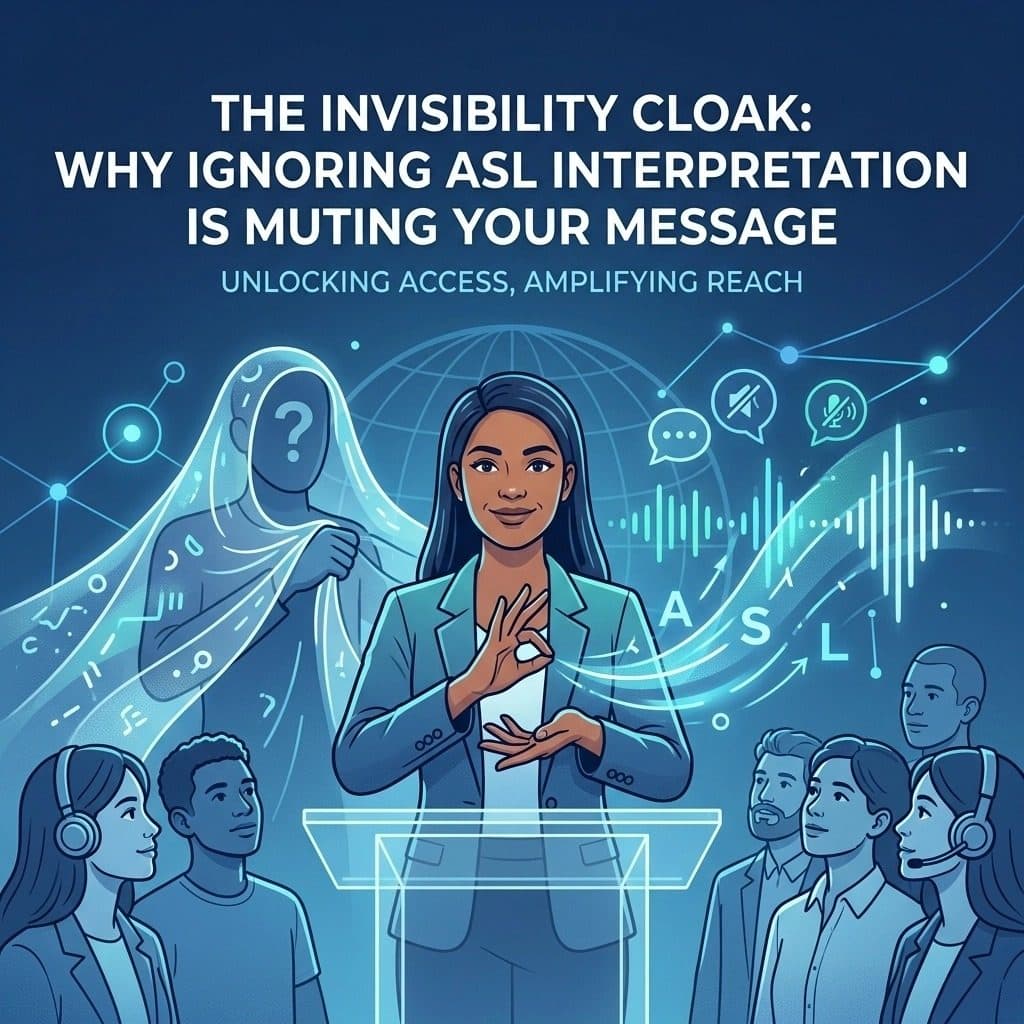
Imagine hosting the grandest gala of the decade, a corporate summit that promises to “disrupt the industry,” or a product launch destined to change the world. You’ve spent months perfecting the lighting, the catering is divine, and your keynote speaker is a literal rockstar of the tech world. But then, as the first words are spoken, you realize you’ve wrapped your entire message in an invisibility cloak. Not the cool Harry Potter kind that lets you sneak into the restricted section of the library, but the kind that renders your brilliant ideas completely inaccessible to a massive segment of your potential audience. When you skip out on high-quality ASL interpretation services, you aren’t just being forgetful; you are effectively muting your own brand.
There is a persistent, nagging myth in the American business landscape that providing accessibility is a “nice-to-have” or a charitable box to check. We often think of it as a niche requirement for a tiny group of people. However, if we look at the data, the reality is a stark contrast to these assumptions. Millions of Americans are Deaf or hard of hearing, and for many of them, American Sign Language (ASL) is their primary, and often preferred, language. If you ignore this reality, you are essentially telling a significant portion of the market that their business, their talent, and their attention simply aren’t worth the effort. In essence, you are choosing to be invisible to them.
The problem often starts with a fundamental misunderstanding of what sign language actually is. Many people assume it’s just English performed with hands: a sort of word-for-word manual code. If that were true, maybe a basic AI or a hobbyist could do the trick. But it isn’t true. ASL is a rich, complex, and fully realized language with its own unique syntax, grammar, and cultural nuances that are entirely separate from English. This is why professional interpretation services are not a luxury but a functional necessity. When you hire someone who isn’t one of our highly trained, Master’s-level linguists, you aren’t just losing some “flair”; you are losing the core of your message.
Consider the rhythm of a great speech. It’s not just the words; it’s the pauses, the emphasis, the dry wit, and the subtle shifts in tone. A qualified interpreter captures all of that, translating the intent and the impact of the speaker, not just the literal vocabulary. When businesses settle for “good enough” interpretation, they risk their message becoming a garbled, confusing mess. Is “good enough” really the standard you want for your global brand identity? If you wouldn’t settle for a glitchy, half-broken website, why would you settle for a glitchy, half-baked communication strategy?
Speaking of events, the stakes get even higher when you move into the spotlight. Whether it is a town hall meeting or a massive industry conference, the presence of an interpreter changes the energy of the room. It signals to everyone: Deaf and hearing alike: that this organization values inclusion and professional excellence. We have seen time and again that ASL/Corporate Events are more successful when the interpretation is integrated from the start, rather than being a frantic afterthought. If you wait until the day before the event to look for ASL interpretation services, you’ve already failed the first test of professional event planning.
The legal reality is another elephant in the room that many prefer to ignore. In the United States, the Americans with Disabilities Act (ADA) isn’t a suggestion; it’s the law. Failing to provide effective communication can lead to more than just a PR nightmare; it can lead to actual litigation. But beyond the fear of a lawsuit, there is the risk of reputational damage. In the age of social media, a video of a poorly handled event can go viral in minutes. If your brand is seen as exclusionary or, worse, incompetent in its accessibility efforts, that’s a stain that is very hard to wash out. Americans who challenge these assumptions don’t understand that true global leadership requires looking beyond the “standard” English-speaking audience.
Let’s talk about the specific expertise required for this kind of work. At Auerbach International, we emphasize that our team consists of Master’s-level linguists because the nuance required for highstakes interpretation is immense. They aren’t just “signing”; they are performing a high-wire act of simultaneous cognitive processing. They are listening to one language, processing the meaning, and then outputting it in a completely different grammatical structure, all while maintaining the emotional tone of the speaker. This is why ASL Interpretation is a specialized field that demands the same level of respect as any other high-tier professional service.
The benefits of a comprehensive language strategy extend far beyond the stage. Often, a company that requires ASL for an event also has broader needs, such as professional translation services for their training manuals, safety protocols, or marketing materials. A holistic approach ensures that no matter how a person interacts with your brand: whether they are reading a document, watching a video, or attending a seminar: the experience is seamless and professional. In essence, you are building a bridge instead of a wall.

BLOOPERS: WHEN “WASHING YOUR HANDS” OF THE PROBLEM GOES WRONG
Of course, the world of translation and interpretation is ripe with examples of what happens when organizations try to cut corners. We’ve all seen the news reports that make us cringe. There was the infamous case of the fake interpreter at the Nelson Mandela memorial service, whose nonsensical hand movements left the entire Deaf community: and the world: in a state of shock. It wasn’t just a failure of communication; it was a profound sign of disrespect on a global stage.
Then there are the less famous, but equally disastrous, local bloopers. Imagine a police press conference where the “interpreter” is actually just signing “pizza” and “clown” while the official is discussing a serious public safety threat. Or the corporate training video where the interpreter’s lack of technical knowledge leads them to sign that a machine is “happy” instead of “operational.” These aren’t just funny anecdotes; they are warnings of what happens when you don’t vet your providers. If you think professional services are expensive, wait until you see the bill for cleaning up a global PR disaster caused by an amateur.

The path forward is actually quite simple. It begins with acknowledging that accessibility is an integral part of your communication strategy, not an optional add-on. It means looking at your upcoming calendar and asking, “How are we ensuring everyone in this room: or on this stream: can actually hear us?” It means partnering with a firm that understands the complexities of interpretation services and has the track record to prove it. For over 35 years, we have helped companies strip away that invisibility cloak and step into the light of true, clear communication.
In essence, ignoring ASL is like printing a brochure in a font so small it can’t be read, or building a store with no front door. You might be “open for business,” but you aren’t actually welcoming anyone in. When you choose to invest in high-quality, professional ASL interpretation, you aren’t just fulfilling a requirement; you are expanding your reach, protecting your brand, and proving that your message is meant for everyone.
CONCLUSION
True global communication requires the courage to be seen and understood by all audiences, without exception.