

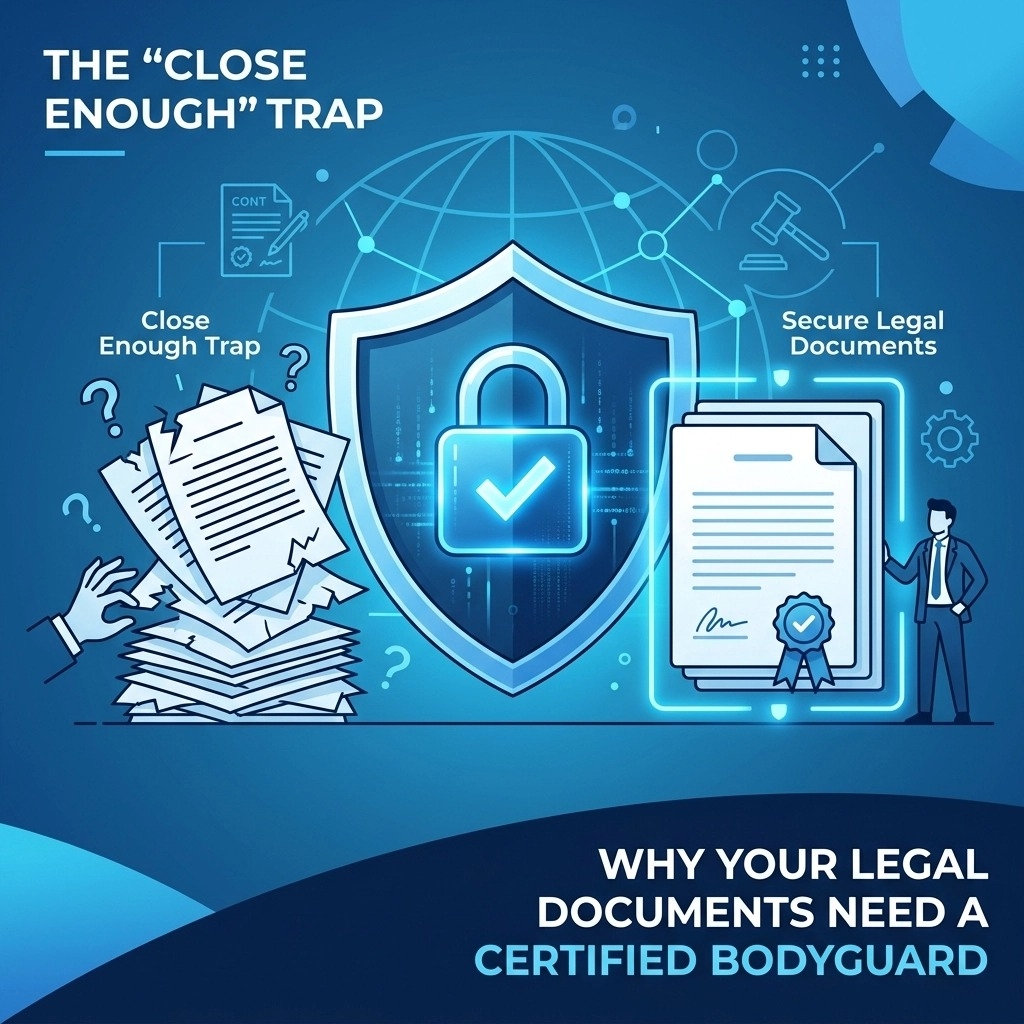
The courtroom is a place of absolute precision where a single misplaced comma can cost a corporation millions or land a well-meaning executive in a foreign jail. Yet, in our rush to go global, there is a growing and dangerous temptation to believe that language is a commodity. We see the sleek interfaces of modern AI tools and think that translation is just another automated task to be checked off a list. We fall into the seductive lie of "close enough." In the world of marketing, "close enough" might lead to a funny social media post. In the world of legal translation services, "close enough" is a trap that triggers a cascade of litigation, rejected filings, and broken contracts.
Imagine you are finalizing a major distribution agreement in a civil law jurisdiction. You’ve spent months negotiating the terms. To save time and budget, you run the final contract through a popular AI translator. It looks professional. The grammar is flawless. The formatting matches your original document perfectly. However, the AI translates the term "shall" into a target language equivalent that implies a "suggestion" rather than a "binding obligation." In essence, you have just handed your partner a legal exit ramp they never asked for but will certainly use when things get difficult. This is why your legal documents require more than just a translator. They need a certified bodyguard.
THE ILLUSION OF THE AUTOMATED PARALEGAL
We live in an era where technology promises to democratize expertise. While software is incredible for website translation or getting the gist of a casual email, it lacks the discernment required for the high-stakes world of international law. AI operates on probability, not on an understanding of the law. It predicts the next most likely word in a sequence based on a massive dataset. It does not un- derstand the difference between a "condition precedent" and a "condition subsequent" in a nuanced legal context.

When an American company enters a foreign market, they often assume that legal concepts are universal. They are not. Most of the world operates under Civil Law, which is vastly different from the Anglo-American Common Law system. If your translation tool doesn't know that "consideration" has a very specific meaning in a US contract that doesn't necessarily exist in the same way in a French or Japanese court, you are already in trouble. A Master's-level linguist doesn't just swap words; they act as a bridge between two entirely different legal realities. They ensure that the intent of the document survives the border crossing.
THE ANATOMY OF A LEGAL BODYGUARD
What does it mean to have a certified bodyguard for your documents? At Auerbach International, we have spent over 35 years refining a process that prioritizes accuracy above all else. This isn't about being "fluent." Being fluent in a language is the bare minimum requirement for a translator. For legal work, you need a subject-matter expert who understands the penal codes and judicial structures of both the source and target countries.
A certified document translation is more than just a verified text. It is a legal record that the translation is a true and accurate representation of the original. This certification is often a strict requirement for immigration filings, patent applications, and court evidence. If you show up to a government agency with an AI-generated document and a shrug, your application will likely be rejected before you can even explain the cost savings. Professional linguists provide a shield. They stand behind their work with the weight of their credentials and our agency's reputation.
THE HIDDEN RISKS OF "ALMOST" ACCURATE
Many of our clients come to us after a "close enough" disaster. They might have used a bilingual employee or a generalist translation firm that didn't specialize in legal terminology. Of course, the results are often embarrassing, but the financial risks are far worse. If a technical manual for a piece of heavy machinery is translated with "almost" the right safety warnings, the liability resides squarely with the manufacturer. We often see this overlap between legal and technical translation services, where the law requires specific warnings to be phrased in a precise, legally mandated way.
In essence, an uncertified translation is a vulnerability. It is an open door for an opposing counsel to challenge the validity of a contract or the admissibility of evidence. If you cannot prove that the person who translated your document was a qualified, Master's-level professional, how will you know if they missed a nuance that changes the entire outcome of a trial? Americans who challenge these assumptions often don't understand that many foreign courts are far more rigid regarding document formalities than our own.
BLOOPERS FROM THE "CLOSE ENOUGH" FILES
To illustrate the danger, let’s look at how "close enough" can go spectacularly wrong in a way that would be funny if it weren't so expensive. In one instance, a company translated a contract clause regarding "termination for convenience." The automated tool translated this into a phrase that suggested the contract could only be terminated if it was "comfortable" for both parties to do so. This created a two-year legal stalemate because the word "convenience" has a specific legal weight in English that was entirely lost in the literal, non-legal translation.

In another case, a patent application was delayed for months because a generalist translator used the common word for "glass" instead of the specific technical and legal term for a "borosilicate compound." While both are technically glass, the legal protection requested was for the specific compound. The "close enough" translation made the patent so broad that it was unenforceable. This is why subject-matter expertise is not a luxury; it is a prerequisite for global success.
THE MASTER'S-LEVEL DIFFERENCE
When we talk about a Master's-level linguist, we are talking about a professional who has dedicated their life to the study of language and its application in specific fields. These are individuals who understand that a translation for a court in Madrid is different from a translation for a court in Mexico City, even though both use Spanish. They recognize the regionalisms, the local statutes, and the cultural expectations of the judiciary.
If you are dealing with sensitive documents, you have to ask yourself a critical question. Would you hire a bodyguard who only "mostly" knows how to use a radio and "sort of" knows how to identify a threat? Probably not. You want someone who has been trained, certified, and has a proven track record of protection. Your legal documents deserve that same level of security.

BEYOND THE WORDS: CULTURAL ADAPTATION
Legal translation is also a form of cultural adaptation. In some cultures, the tone of a legal document needs to be significantly more formal and flowery than the standard dry, American "legalese" to be taken seriously by a judge. Conversely, in other regions, overly complex language can be seen as an attempt to hide the truth. Our experts navigate these cultural waters, ensuring that your document doesn't just say the right things but is received in the right way.
This level of nuance is why our language services and interpretation team remains the gold standard. Whether it is a written contract or a live deposition, the need for human discernment is absolute. Technology is a tool, but it is not the craftsman. It cannot understand the weight of a person’s reputation or the complexity of a multi-national merger.
CONCLUSION
In the high-stakes game of international business, the "close enough" trap is the shortest path to failure. Legal documents are the foundation of your global expansion, and they require the protection of certified, human expertise to ensure they hold up under pressure. Precision is not a suggestion; it is a requirement.
Auerbach International provides the professional, Master's-level bodyguard your documents need to survive and thrive in any jurisdiction.

