

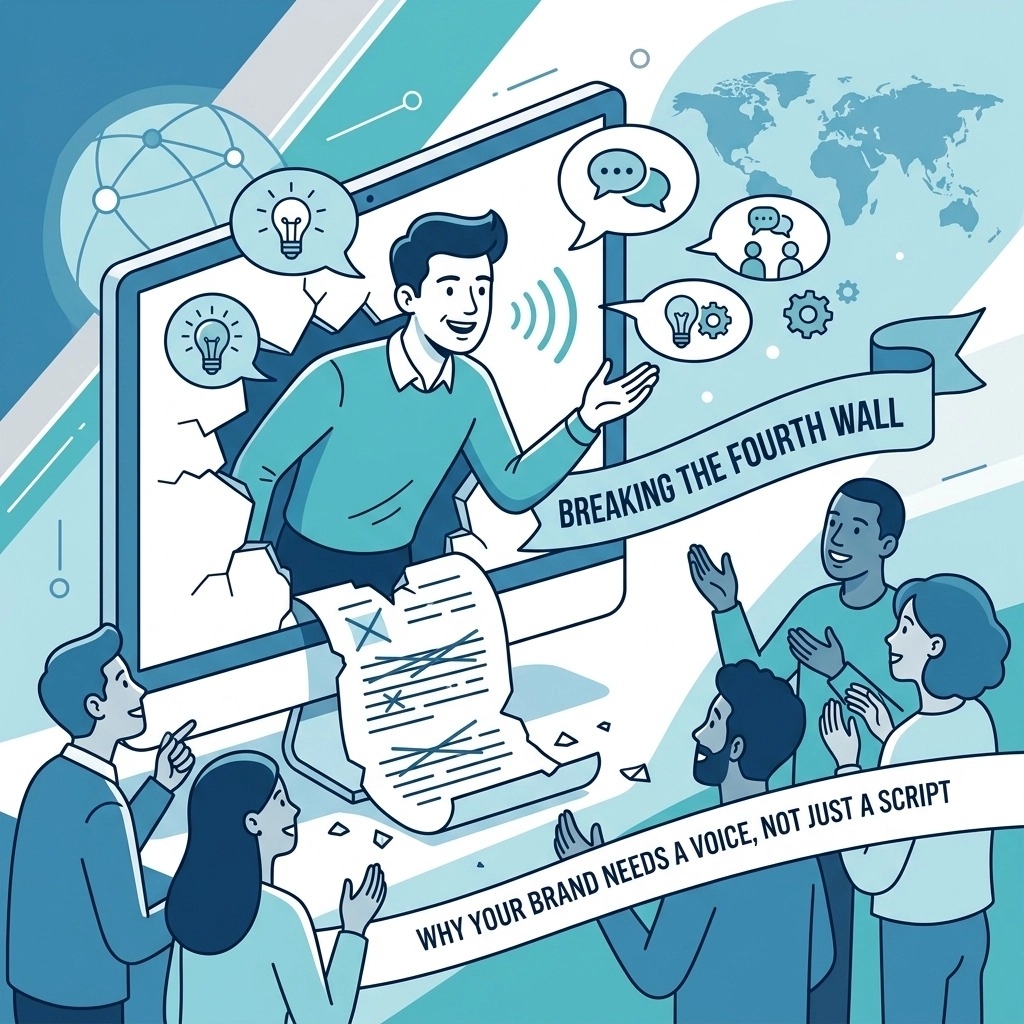
In the theater, "breaking the fourth wall" happens when an actor stops pretending the audience doesn't exist and speaks directly to them. It is jarring, it is intimate, and it is incredibly effective. In the world of global marketing, brands often spend millions of dollars building a massive, beautiful wall between themselves and their customers without even realizing it. They do this by hiding behind a script: a literal, rigid, and often poorly translated set of words: instead of developing a voice that resonates across borders.
At Auerbach International, we have spent over 35 years watching companies try to scale this wall. Many of them believe that if they simply translate their English script into French, Japanese, or Portuguese, the job is done. They assume that the words are the message. But words are just the vehicle. The voice is the engine. If you want your brand to actually connect with a human being in a different hemisphere, you have to stop performing at them and start communicating with them.
Is "good enough" translation good enough for your brand identity? Usually, the answer is a resounding no. When you treat your marketing copy like a set of instructions for a toaster, you lose the humanity that makes people buy things in the first place. This is where the transition from a script to a voice begins.
The Script Is a Performance, the Voice Is a Relationship
Audiences today are exhausted. They are bombarded with thousands of scripted pitches every day, and they have developed a keen sense for when they are being marketed "at" rather than spoken "with." When a brand stays scripted, it remains transactional. It feels like a robot reading a teleprompter. In contrast, an authentic voice signals transparency and trust. It tells the customer that there is a real person on the other side of the screen who understands their world.

Consider how Ryan Reynolds or the Old Spice campaigns handle their messaging. They acknowledge the absurdity of the advertisement itself. They wink at the audience. They break the wall. Now, imagine trying to do that in a different language without professional interpretation or localization expertise. A joke about American insurance in a Mint Mobile ad doesn't just need to be translated; it needs to be reimagined for a consumer in Berlin or Tokyo. If you stick to the script, the joke dies on the vine. If you find the voice, the brand lives.
In essence, a script tells people what you sell, but a voice tells them who you are. Americans who challenge the necessity of high-end localization often don't understand that a brand's "cool factor" is the most fragile thing it owns. One stiff, overly formal sentence can turn a trendy tech startup into a stodgy, out-of-touch conglomerate in the eyes of a foreign consumer.
The Master's-level Linguist as Your Brand Guardian
If you want to move beyond the script, you cannot rely on automated tools or amateur enthusiasts. This is where the expertise of a Master's-level linguist becomes non-negotiable. These are not just people who know two languages; they are experts in the cultural architecture of the target region. They understand that a marketing campaign in Brazil requires a completely different energy than one in Portugal, even though they share a base language.
When we handle technical translation services, we aren't just swapping nouns. We are ensuring that the precision of the engineering matches the expectations of the local professional. If your technical manual reads like a bad haiku because of a literal translation, you haven't just failed to provide instructions; you've damaged your brand's authority.
The same applies to legal translation services. A contract is a script with high stakes. If the voice of that contract is ambiguous or culturally insensitive, the relationship between partners can sour before the ink is dry. A professional linguist acts as a bodyguard for your brand’s integrity, ensuring that the "voice" of your company remains professional, authoritative, and legally sound in every jurisdiction.

The High Stakes of Audio and Visual Localization
Voiceovers and dubbing are perhaps the most literal ways a brand finds its voice. Yet, this is often where the most egregious errors occur. Have you ever watched a sleek, high-budget brand video where the voiceover sounded like a 1990s GPS system? That is the sound of a brand failing to break the fourth wall.
When a brand invests in professional transcription and voiceover services, they are looking for more than just a clear recording. They are looking for an actor who can convey the brand's personality. Is your brand cheeky? Is it stoic? Is it adventurous? These traits are carried in the inflection, the pacing, and the tone of the voice. A literal translation of a script might fit the timing of a video, but it will fail to capture the soul of the message.
If you are expanding into the Philippines or Brazil, for example, the "voice" of your brand might need to be warm and community-focused. In these cultures, business is often conducted over coffee and pastries, and the marketing voice should reflect that hospitality. If you use a cold, overly clinical script, you are essentially keeping the fourth wall locked tight. You are telling the audience that you don't really know them.
The If-Then Logic of Global Growth
If you treat localization as an afterthought, then your global launch will likely underperform. If you prioritize the "script" over the "voice," then your brand will appear as a stranger in a strange land. However, if you embrace the nuances of culture, then you create a genuine partnership with your audience.
This requires a shift in mindset. You have to move from "us versus them" to a "we." A brand that speaks to a global audience in their own cultural shorthand isn't just selling a product; it’s building a community. This is why we insist on native speakers and subject-matter experts. They are the only ones who can tell you when a phrase that works in Chicago will fall flat in Santiago.

BLOOPERS
Even the biggest companies with the most expensive "scripts" fall into the trap of literalism. We have seen a famous fast-food chain tell Chinese customers that their food will "eat your fingers off" instead of being "finger-lickin' good." We have seen an American vacuum manufacturer try to sell their product in the UK with the slogan "nothing sucks like a Hoover," unaware of the colloquial implications. There was the legendary case of a car company trying to sell the "Nova" in Latin America, which literally translates to "it doesn't go." These are not just funny stories; they are the result of brands following a script while being deaf to the local voice. In each of these cases, the fourth wall wasn't just broken; it collapsed on top of the brand.
Beyond the Subtitle Shuffle
Many brands think they can solve the "voice" problem with subtitles. While subtitles are a vital part of accessibility, they are often just a layer of text on top of a foreign experience. They keep the audience at a distance. To truly break the wall, you need to immerse the viewer. You need localized graphics, culturally relevant references, and audio that feels like it was recorded next door, not in a studio halfway across the world.
When we talk about breaking the fourth wall, we are talking about transparency. We are talking about showing the world that your brand is ready to meet them where they are. Whether it is through complex document translation or high-energy marketing dubs, the goal is the same: to remove the barriers to understanding.
CONCLUSION
In essence, your brand is more than a collection of products; it is a story. To tell that story globally, you cannot simply hand out translated scripts and hope for the best. You need to develop a voice that is authentic, culturally resonant, and consistently professional. By breaking the fourth wall and speaking directly to your international customers, you build a foundation of trust that no literal translation can ever achieve. Don't let your brand get lost in the shuffle of "close enough." Give it the voice it deserves.

