

Imagine a marketing executive sitting in a high-rise office in San Francisco, reviewing a beautifully produced three-minute brand video that has just been finalized after months of work. They see the vibrant colors, the sleek transitions, and the emotionally resonant music, and they decide that the only thing standing between this masterpiece and global success is a simple text file containing a few dozen translated sentences. This is the precise moment where many companies unknowingly sabotage their own international expansion by assuming that translation is merely a matter of swapping words. At Auerbach International, we have spent over thirty-five years observing how the gap between a subtitled video and a truly localized experience can make or break a company’s entry into a new market. While the common American assumption is often that English is the universal language of business, the reality of global consumer behavior tells a much more complex story. In essence, simply adding subtitles to a video is like putting a fresh coat of paint on a house with a crumbling foundation; it might look acceptable from a distance, but it fails to address the underlying structural requirements of the local environment and the psychological needs of the viewer.
When we consider the technicalities of high-quality video production, we must look at the way the human brain processes visual information in different cultural contexts. Studies have shown that dubbed or deeply localized content can achieve three to five times higher engagement rates than content that relies solely on subtitles. This is because reading subtitles requires a cognitive split where the viewer must divide their attention between the action on the screen and the text at the bottom. For a viewer in Brazil or the Philippines, where cultural consumption of media is often a communal or high-energy experience, this constant oscillation can lead to fatigue and a lack of emotional connection with the brand message. This is where our expertise in language-services-translation moves beyond the superficial to the substantial. True localization involves a Master’s-level understanding of how cultural nuances dictate the reception of a message, ensuring that the viewer is not just reading the story but actually feeling it.

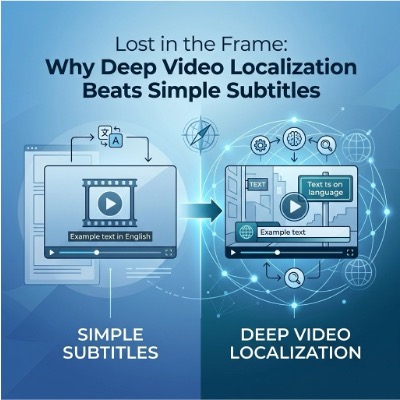
Consider the risk of relying on automated subtitle generation or basic translation services for a com-plex product demonstration or a high-stakes corporate training video. In the realm of technical-translation-services, a single mistranslated decimal point or a misunderstood safety warning can lead to catastrophic legal liabilities. If a company fails to localize the on-screen text, the signs, the lower-thirds, the technical diagrams, they are essentially telling their international audience that they are a secondary priority. This is why we emphasize that deep video localization is the backbone of global compliance and brand integrity. If you are launching a medical device or a piece of heavy machinery, a subtitle is not enough to ensure the user’s safety or the company’s legal protection. You need the rigor of certified-document-translation standards applied to every frame of your visual media to avoid the peril of miscommunication.
The visual elements of a video are often just as culturally loaded as the spoken word. A gesture that signifies approval in New York might be a grave insult in another part of the world. A color scheme that suggests professional reliability in the United States might be associated with mourning or bad luck elsewhere. Deep localization involves an audit of these visual cues. If a video features people eating pastries and coffee in a way that feels distinctly American, it might feel alienating to an audience where breakfast rituals are entirely different. By localizing these elements, either through clever editing or targeted reshooting, a brand demonstrates a level of respect and acculturation that simple subtitles can never achieve. It is about moving from being an outsider looking in to being a native participant in the local market. For those ready to take this step, requesting a translation-quote-request is the first move toward a more sophisticated global presence.

To understand the consequences of cutting corners, one only needs to look at the history of translation bloopers that have haunted major corporations for decades. We have seen instances where a major car manufacturer attempted to sell a vehicle in Latin America without realizing the name of the car was a local slang term for lack of virility. We have seen software companies release localized videos where the text was translated but the user interface shown on the screen remained in English, rendering the entire tutorial useless to the target audience. If a developer chooses the cheapest path, then they must be prepared for the brand-ruining errors that inevitably follow. These are not just funny anecdotes; they are expensive lessons in the importance of professional language-services-interpretation and localization. A Master’s-level linguist doesn’t just translate; they protect the brand from these invisible traps.
Furthermore, the technical architecture of the video itself must be considered. When we talk about deep localization, we are also talking about language-services-transcription and the careful timing of voiceovers. If a Japanese sentence takes thirty percent longer to speak than its English equivalent, the video timing must be adjusted or the script must be expertly condensed without losing the core meaning. Simple subtitles often fail here because they become a wall of text that disappears too quickly for the average reader to comprehend. If the viewer cannot keep up with the text, they will simply stop watching. In essence, the user experience is the ultimate metric of success. If the experience is jarring, the brand is perceived as second-rate.

In the modern digital landscape, video is the primary vehicle for storytelling and consumer persuasion. Whether it is a short social media clip or a long-form documentary, the goal is always the same: to create a seamless connection between the creator and the audience. When a company invests in deep localization, they are investing in the longevity of their global relationships. They are moving beyond the "good enough" mentality that plagues so many international marketing departments. We often ask our clients: is your global reputation worth the savings of a few hundred dollars on a cheap subtitle job? If the answer is no, then the path forward is clear. By choosing a comprehensive approach that includes cultural adaptation, on-screen text replacement, and professional voice talent, a company ensures that its message remains clear, its brand remains prestigious, and its legal standing remains secure.

As we look toward the future of global communication, the integration of AI and human expertise will continue to evolve. However, the need for a human touch in localization remains irreplaceable. AI can translate words, but it cannot yet navigate the intricate web of human emotion, regional sarcasm, or the specific historical context of a target audience. Our team at Auerbach International combines the latest technological tools with decades of cultural wisdom to provide a level of service that is as precise as it is evocative. We believe that every frame of your video should speak the language of your customer, not just in terms of vocabulary, but in terms of values and vision.
In conclusion, the choice between simple subtitles and deep video localization is a choice between being a visitor and being a local. While subtitles may provide a basic bridge of understanding, deep localization builds a permanent highway of trust and engagement. If you want your international audience to truly see your brand for what it is, you must ensure that nothing is lost in the frame. We invite you to explore our archive of success stories and reach out to us to see how we can transform your visual content into a truly global asset.

